
Dholera Special Investment Region is no longer a plan on a map. In mid-2026, India’s first commercial semiconductor fab is under construction inside its boundary, a 300 MW solar park has been running for years, an international airport completed a trial landing in June 2026, and the expressway linking it to Ahmedabad is open. This article covers what’s actually happening in Dholera’s industrial build-out, what’s still in progress, and the role smart urban transport — including a proposed monorail system — plays in its long-term vision.
What Makes Dholera SIR Different From Any Other Indian Development
Dholera SIR is a 920 sq. km greenfield city in Gujarat — larger than Singapore — jointly developed by the Government of India (49%, through NICDC Trust) and the Government of Gujarat (51%, through DSIRDA) via a special purpose vehicle called Dholera Industrial City Development Limited (DICDL). It is the flagship node of the Delhi–Mumbai Industrial Corridor (DMIC), a joint India–Japan infrastructure initiative designed to create a globally competitive industrial belt between the two cities.
What separates it from most Indian industrial estates is its sequence: infrastructure was built before industries arrived, not after. The 22.5 sq. km Activation Area now has smart roads up to 75 metres wide, fully underground utilities — water, drainage, power, fibre — and power supplied through substations run by Tata Power and Torrent Power. That base is what makes the larger industrial announcements credible rather than speculative.
Key distinction: Dholera SIR is a publicly funded, government-regulated Special Investment Region — not a private township project. DICDL’s governance structure and DSIRDA oversight give it a legal and institutional backing that most plotted developments in India don’t have.
The Industrial Anchor: Tata Electronics Semiconductor Fab
The single most significant development in Dholera SIR’s industrial story is the Tata Electronics semiconductor fabrication facility — India’s first commercial chip fab, being built in partnership with Taiwan’s Powerchip Semiconductor Manufacturing Corporation (PSMC). The facts on this project are unusually well-documented, since both the Government of India and Tata Electronics have made formal announcements at multiple stages.
| Specification | Verified Detail |
|---|---|
| Total investment | ₹91,000 crore (~$11 billion) |
| Technology partner | Powerchip Semiconductor Manufacturing Corporation (PSMC), Taiwan |
| Planned monthly capacity | Up to 50,000 wafers (28nm–110nm analog and logic chips) |
| Applications | Automotive, AI, telecom, consumer electronics, defence |
| Construction progress (April 2026) | ~50% complete |
| SEZ notification | 66.166-hectare SEZ formally notified April 13, 2026 |
| Equipment partner | ASML (strategic partnership confirmed May 2026) |
| Trial production target | Late 2026 (December 2026 cited by Tata Electronics CEO) |
| Direct and indirect jobs (Phase 1) | Over 20,000 skilled positions |
| Central government subsidy | Up to 50% of project cost under India Semiconductor Mission |
Source: Tata Electronics official announcements, Government of India India Semiconductor Mission, and BusinessToday (July 2026). Trial production timelines are targets, not guaranteed completion dates — verify directly with DICDL or Tata Electronics for current status.
The Ecosystem Building Around the Fab
A semiconductor fab doesn’t operate alone — it requires a tightly integrated supply chain of specialty materials, gases, equipment support, and logistics. What’s notable about Dholera in mid-2026 is that this ecosystem is already arriving, not just anticipated.
- INOX Air Products has begun constructing a specialty gas facility inside Dholera SIR to supply the ultra-high-purity gases the Tata fab requires — an indicator that the project’s timeline is taken seriously by industrial suppliers.
- Japanese firms Nagase and Nippon Express have partnered to support semiconductor supply chain operations in the region.
- ASML, the Dutch maker of the world’s most advanced lithography equipment, confirmed a strategic partnership with Tata Electronics in May 2026.
- Union Budget 2026 allocated ₹40,000 crore nationally for India’s semiconductor manufacturing ecosystem, with Dholera as the primary beneficiary location.
- Tillman Global has proposed a $10 billion data centre investment in Dholera — a significant proposal, though not yet confirmed as a signed commitment at time of writing.
The convergence of a large anchor project, specialized suppliers already on-site, and national policy funding is what distinguishes this phase of Dholera’s development from earlier years of planning-stage announcements.
Connectivity: What’s Confirmed and What’s Still Coming
The Ahmedabad–Dholera Expressway
The 109 km expressway inaugurated on 31 March 2026 is the region’s most important current connectivity asset. It cuts travel from Ahmedabad to Dholera SIR from over two hours to roughly 40–60 minutes. For industries already operating in or committing to the region, this is the primary logistics and workforce route.
Dholera International Airport
On June 5, 2026, an Airports Authority of India aircraft completed a trial landing at Dholera International Airport — a concrete milestone that moves the project from construction into testing. Commercial operations have not yet been confirmed, and no official opening date has been issued by AAI. When operational, the airport is expected to significantly improve cargo movement and industrial logistics for the SIR.
The Smart Urban Transport Vision — Including Monorail
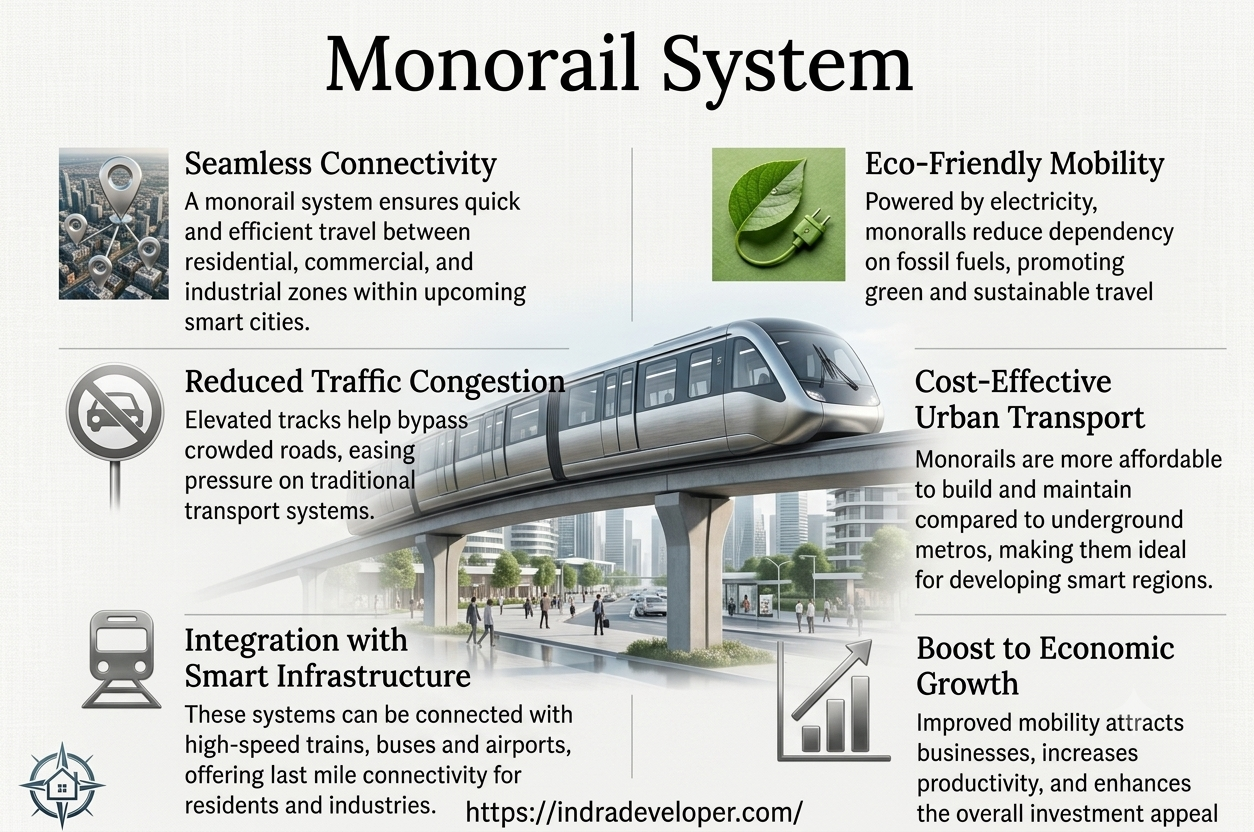
Dholera SIR’s master plan envisions an integrated urban mobility network connecting its residential, commercial, and industrial zones. One element discussed in long-term planning documents is a monorail-type elevated transit system, which would offer last-mile connectivity within the city without adding to surface road congestion. The characteristics that make monorail systems attractive for a planned smart city — electric propulsion, elevated tracks, integration with high-speed rail and airport links, lower construction cost than underground metro — align well with Dholera’s sustainability goals and its pre-planned street network.
It’s important to be clear: an internal Dholera monorail is part of the long-term vision, not a confirmed funded project with a construction timeline. Its relevance today is as a design principle — Dholera’s streets and utility corridors are being built to accommodate future transit infrastructure, rather than being laid out in ways that would make it difficult to add later. That forward planning is part of what distinguishes a greenfield smart city from retrofitted urban development.
Energy: The Dholera Solar Park
Reliable, clean power is a prerequisite for semiconductor manufacturing, data centres, and the other energy-intensive industries Dholera is attracting. The Dholera Solar Park’s first 300 MW phase, developed by Tata Power, has been operational since 2022. Planned eventual capacity runs up to 5,000 MW (5 GW) in later phases, with additional phases under tendering and construction. For a semiconductor fab that requires uninterrupted, ultra-stable power, a city with an established solar park and smart grid infrastructure is a meaningful operational advantage over a location where power reliability needs to be resolved from scratch.
What Dholera’s Industrial Growth Means for Property
Large-scale anchor industries create housing and commercial demand through a simple chain: industrial investment brings jobs, jobs bring workers, workers need housing and services. The Tata Electronics fab alone projects over 20,000 direct and indirect skilled jobs in Phase 1 — and Tata is already constructing workforce housing within the SIR boundary in anticipation of that demand. Other companies committing to the semiconductor supply chain, solar manufacturing, and data infrastructure add further layers to that employment picture.
This matters for property buyers because it changes the nature of demand from speculative (“land near a planned city”) to increasingly utility-driven (“housing needed near where people will actually work”). That shift does not, however, eliminate the need for legal diligence on any specific plot. RERA registration, the relevant Town Planning scheme and L-Form, NA order confirmation, and the freehold versus leasehold structure of a specific plot remain buyer responsibilities regardless of what’s happening at the industrial level.
The Bottom Line
Dholera SIR in mid-2026 is measurably further along than it was two years ago: the expressway is open, the semiconductor fab is 50% built and has its SEZ formally notified, the solar park has run for years, and the airport cleared a trial landing. The industrial ecosystem — supply chain firms, equipment partners, national policy funding — is arriving around the anchor project rather than waiting for it to complete. The smart urban transport vision, including a potential monorail system, represents a well-designed framework for how the city will move people once those industries and residents are in place. None of this removes the due diligence a property buyer still needs to do on any specific plot — but it gives that diligence a much more solid underlying context to work from.
Frequently Asked Questions
As of April 2026, construction is approximately 50% complete. A 66.166-hectare Special Economic Zone for the facility was formally notified on April 13, 2026. Tata Electronics has confirmed a strategic partnership with Dutch equipment maker ASML, and trial production is targeted for late 2026 — though this is a target date, not a guaranteed completion milestone.
No — an internal Dholera monorail system is part of the long-term smart city master plan vision, not a confirmed funded project with a construction start date. Dholera’s street network and utility corridors are being designed to accommodate future transit infrastructure, but the monorail itself has not been notified or tendered as of mid-2026.
It hosts India’s first commercial semiconductor fabrication plant — Tata Electronics’ ₹91,000 crore fab in partnership with Taiwan’s PSMC, targeting 50,000 wafers per month at 28nm–110nm nodes. An ecosystem of supply chain firms is already building around it, and Union Budget 2026 allocated ₹40,000 crore nationally for semiconductor manufacturing, with Dholera as a primary beneficiary.
Large anchor industries create a chain: jobs bring workers, workers need housing and services. The Tata fab alone projects 20,000-plus skilled jobs in Phase 1, and Tata is already building workforce housing within Dholera SIR. This shifts property demand from speculative interest toward utility-driven need — though it doesn’t change the legal due diligence a buyer must do on any specific plot.
Dholera SIR is governed by DICDL — a joint SPV of the Government of India (49%, via NICDC Trust) and the Government of Gujarat (51%, via DSIRDA). This dual-government governance structure provides institutional oversight, legal zoning framework, and planning protection that private township projects don’t have. Buyers should confirm that any plot they consider sits inside the DICDL-planned boundary and carries the relevant DSIRDA approvals.